
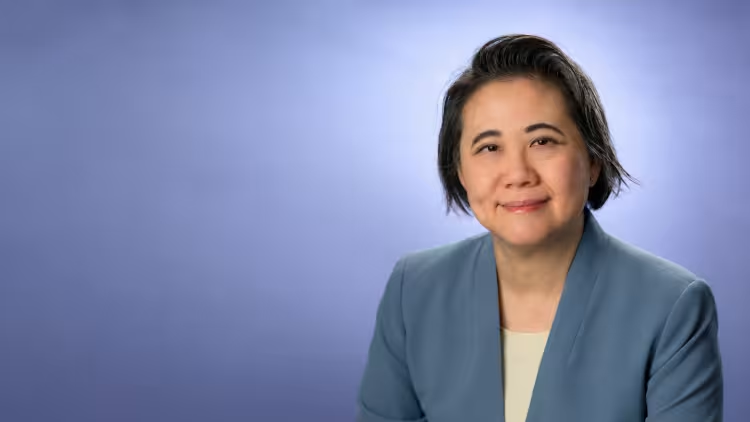
Hi Lillian, thanks for finding the time to speak to me at such a busy time. You sit at the intersection of clinical oncology and early-stage drug development – what do you see as the biggest gaps in translating science into first-in-human trials?
I see the persistent disconnect between preclinical research and the biological complexity of patients who ultimately enter these studies as a real gap.
Target validation, biomarker development, dosing and scheduling – decisions around these are still largely informed by models that fail to capture tumour heterogeneity, the effects of prior lines of therapy, and the influence of the immune microenvironment. While there is a clear need for more reliable and predictive models, I believe equal emphasis must be placed on leveraging existing knowledge and enabling real-time, adaptive learning within clinical development.
In a recent Cancer Cell perspective, my team and I argue that traditional oncology clinical trials are overly rigid and drug-centric. This limits their ability to keep pace with rapid advances in molecular biology, data science, and precision medicine. One way to overcome this is with a patient-centric, data-rich, and adaptive trial paradigm that integrates patient data with preclinical models, real-world evidence, and shared clinical datasets.
The real opportunity is to power approaches like this with modern computation and AI. This goal here is to improve patient-drug matching, increase trial efficiency, and of course to ultimately enhance therapeutic success rates.
Operational complexities and realities of clinical care are often underappreciated.
What do you think drug discovery teams most often underestimate about clinical deployment in cancer patients?
Patient comorbidities, selective pressures from prior treatments, and cumulative toxicities all shape clinical outcomes in cancer patients. They are really important and often underestimated at the drug discovery stage.
Early phase trials frequently enroll heavily pre-treated individuals. In these patients, novel agents can behave quite differently than in organoids or xenograft models derived from treatment-naïve or early-stage tumours. Resistance mechanisms may not yet be established in these models.
I also think operational complexities and realities of clinical care are often underappreciated. Intensive dosing schedules, along with extensive monitoring and investigational requirements, can negatively affect adherence, and patient experience. As a result, patient-reported outcomes are increasingly being incorporated into early phase trials to better understand tolerability and real-world burden from the patient perspective.
Early engagement with clinicians and trial sites is so critical to ensure promising therapies are advanced in ways that are not only biologically sound but also realistically deliverable to patients.
Precision oncology continues to evolve rapidly. What advances you most excited about?
I’m really excited to see the convergence of multi-omic biomarkers, longitudinal sampling through liquid biopsy, and adaptive clinical trial designs.
The field is moving beyond static, single-analyte biomarkers toward integrated molecular and functional signatures that more accurately reflect tumour evolution, therapeutic response, and mechanisms of resistance. Advances in circulating tumour DNA (ctDNA) and other liquid biopsy technologies now enable real-time assessment of treatment response, emerging resistance, and molecular residual disease (MRD). These tools can be directly embedded into clinical trials to guide dynamic decision-making.
Adaptive platform trial designs will, I think, complement these advances by allowing multiple hypotheses to be tested efficiently and ineffective strategies to be discontinued early. When combined with precise patient stratification, this flexibility allows us to learn quickly to improve both the speed and success rate of oncology drug development.
Many oncology programmes show early promise but fail in later-stage trials. In your experience, what are the most common disconnects between early clinical signals and eventual success?
One of the most common reasons is the overinterpretation of early efficacy signals generated from small, highly selected patient populations. Early phase studies may report encouraging response rates, but these signals often do not fully capture other critical dimensions – the durability of response, disease stabilisation, mechanisms of emerging resistance are also hugely important. Patients enrolled in early trials frequently have better performance status or more favorable disease characteristics than those who will ultimately be treated in larger, later phase studies.
Programs that succeed are those that continuously integrate biological insight with evolving clinical evidence across all stages of drug development.
Dose optimisation represents another major disconnect between early and late development. Determining dose based solely on maximum tolerated dose rather than long term tolerability and biological activity can lead to unnecessary toxicity and compromised outcomes when a therapy is scaled to broader populations.
Early phase combination studies present additional challenges. Disentangling the individual contributions of each agent is often difficult, particularly when multiple potentially active drugs are combined. Regimens that appear synergistic in early trials can even later reveal cumulative toxicity.
Addressing these challenges requires disciplined decision-making. Teams need to be willing to pause, adapt, or pivot when emerging data do not support broader development. Programmes that succeed are those that continuously integrate biological insight with evolving clinical evidence across all stages of drug development.
Collaboration between academia, biotech, and big pharma is increasingly essential. What models of partnership do you think are proving most effective – and where is there still untapped opportunity?
Partnerships that emphasize shared data, joint decision-making, and distributed risk – particularly in early clinical development – tend to deliver the most durable insights and relevant outcomes.
Academic centers contribute multi-disciplinary disease expertise, translational insights, and access to well-characterised patient populations. Biotechnology companies bring speed, creativity, and a willingness to challenge conventional development paradigms, while large pharmaceutical organisations provide the scale, operational rigor, and global infrastructure required to translate promising science into approved therapies.
I think the most significant untapped opportunities for partnerships are in areas at the intersection of biology, technology, and clinical practice. Early cancer detection and prevention, is a good example. As are MRD assessment and treatment optimisation. These domains are particularly well suited to cross-sector collaboration and represent opportunities for the next generation of high impact partnerships.
Looking ahead, what key scientific or translational themes do you believe will shape the next wave of cancer drug development?
I think it’ll be driven by deeper biological precision, smarter clinical trials, and a strong emphasis on patient-centered outcomes.
Key scientific and translational themes include targeting tumour plasticity and therapeutic resistance, advancing rational combination strategies and expanding immune modulation beyond checkpoint inhibition. Of course, these will go alongside the responsible integration of artificial intelligence/machine learning.
We will also see increasing focus on early interception, MRD, and prevention strategies guided by molecular risk profiling. From a translational perspective, embedding real-time, dynamic biomarkers and ways of learning from both intrinsic patient data and extrinsic knowledge into clinical trials will be critical to accelerate progress and improve outcomes.
About Lilian Siu
Lillian Siu is a Senior Scientist at the Princess Margaret Cancer Centre, University of Toronto. She is the current President of the American Association of Cancer Research and member of the Clinical Advisory Board of Cancer Research Horizons.