
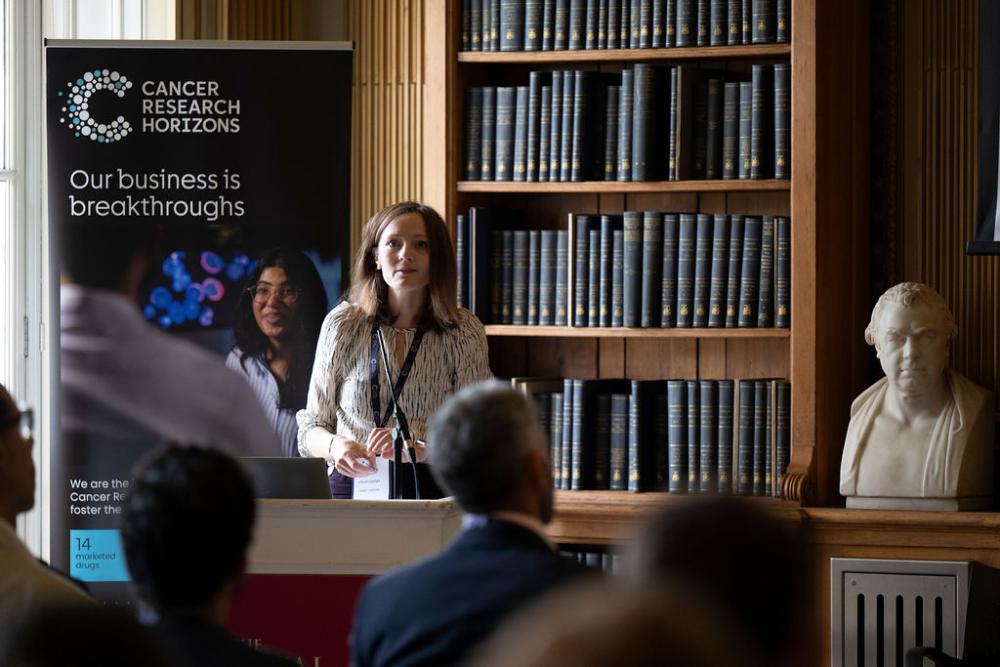
After the latest On the Horizon event at the Royal Society, where Cancer Research Horizons brought investors, company founders, industry and researchers together to discuss the burgeoning area of in-vivo CAR-T therapy, it’s clear enthusiasm for the field is real.
It’s easy to understand why. Over the last decade, CAR-T therapy has generated a lot of excitement and pharma investment, more importantly, it has delivered incredible breakthroughs for some haematological malignancies.

The first CAR-T therapy – Tisagenlecleucel (Kymriah), resulting from a collaboration between the University of Pennsylvania and Novartis – received FDA approval in 2017 to treat children with acute lymphoblastic leukemia. Other approvals soon followed to treat adults with blood cancers like non-Hodgkin lymphoma and multiple myeloma.
However, initial excitement, certainly from investors, has cooled.
Application of CAR-T therapy to other cancer types has so far been slow and there are clear limitations – high costs, labour-intensive manufacturing, and stringent patient selection – to the approach. So, as a second wave of VC investment stalls, alternative approaches to enable the full potential of CAR technology have become very interesting prospects indeed.
In vivo CAR-T cell engineering, where CAR-T cells are generated directly inside the patient’s body, potentially eliminates the need for the ex-vivo cell processing, lymphodepletion and complex logistics associated with traditional CAR-T platforms.
The following points have been synthesised from the reflections, thoughts and discussion points covered by the experts who came together for the On the Horizon event.
The science
- in vivo CAR-T involves direct infusion of vector particles into the patient. These vectors contain CAR transgenes which selectively transduce circulating T cells in-situ to express Chimeric Antigen Receptors, allowing the modified cells to specifically recognise, destroy cancer cells and then multiply.
- The approach holds the potential to transform CAR T-cell therapy into an off-the-shelf, universally accessible platform. Nonetheless, significant challenges remain, including; targeting specificity, transduction efficiency, persistence of therapeutic effect, and safety.
- Perhaps surprisingly, it has been shown that efficacy (per cell potency) decreases with the length of ex-vivo expansion (the phase where the engineered T cells are grown in a lab to generate a therapeutic dose). This was a key scientific driver of an in-vivo approach for CAR-T – the hypothesis being that the complete removal of ex-vivo expansion will be more efficacious.

- This, combined with the likelihood that immune cells not removed from the body will be healthier physiologically, the potential for a multi-immune response, and the possibility of being able to access a broader – more physiologically relevant – T-cell repertoire, further add to the rationale for an in-vivo approach.
- An important research focus is on the vectors used to deliver the transgene to T-cells. The main activity here is around viral vectors – lentivirus and adeno-associated virus – but nonviral systems such as lipid nanoparticles are also being looked at. Absolutely key is ensuring that gene delivery is restricted to T-cells to prevent off-target transduction. This paper from Sarr Gill and Laura Volta is good on the detail around viral and lipid vectors.
Useful links:
In vivo generation of CAR T cells: biology, delivery platforms, clinical promise, and translational challenges | Blood Immunology & Cellular Therapy | American Society of Hematology
https://www.nature.com/articles/s41573-025-01291-5
The safety
- Ex-vivo CAR-T has known risks including cytokine release syndrome, off-target effects, and insertional mutagenesis.
- Whilst it has been reported that viral vectors can induce unwanted inflammatory responses, there is currently only limited data on safety for in-vivo approaches. The good news is that a lot of the risks associated with ex-vivo CAR-T are well characterised and there are some good early signs that in-vivo CAR-T safety is promising.
Useful links:
https://ashpublications.org/blood/article/144/Supplement%201/2046/531192/Nonclinical-Toxicology-Biodistribution-and
The production
- Main challenges here are around the production of the vectors used for in-vivo CAR-T therapy.
- Viral and lipid nanoparticles are the main vectors used in ex-vivo CAR-T trials – but there are specific requirements for in-vivo delivery. Specificity to T-cells is vital – so any mooted vector must be carefully evaluated for this.

- A promising approach is to engineer the vector to target receptors on the T-cell surface. Several proteins can be targeted to enable entry – and some groups have engineered the delivery particle to reduce immune clearance and enable entry.
- The production challenges here are around quantity and quality of the vectors. More patients could be eligible, therefore the amount needed could be much higher. The quality of the vector will also need to be higher – in terms of both purity and complexity. Vectors will be required to deliver higher, cell-specific, expression and possibly Immune evasion. All of this means more complex development and manufacturing complexity. However, vector manufacturing in general still compares relatively favourable to the complexities of producing the CAR T cells themselves.
In vivo human T cell engineering with enveloped delivery vehicles | Nature Biotechnology
The commercial outlook
- The first wave of ex-vivo CAR-T investment seems to have halted. In contrast to M&A, VC activity has decreased since 2021.
- There has been an increase in investment for in-vivo approaches however. Around $750 million of venture funding has been generated in the last few years – manly for validated targets.
Other than the potential benefits mentioned already, there is interest because ex-vivo CAR-T has such poor accessibility – only 4% of potential patients get access. There is the potential for this to massively improve with an in-vivo approach. In-vivo CAR-T is also considered to be a much more ‘drug-like’ approach, which could make it easier to access health services and providers like the NHS etc.

- The real test, commercially, will be if the approach could be developed to address solid tumours – that is a much bigger market. There is currently no convincing evidence that this can be achieved yet. But that could be where the next big opportunities lay for early-stage oncology investors.
- Overall, an in-vivo CAR-T approach has potential to simplify manufacturing, enhance scalability, lower costs, and increase accessibility.
- However clinical research remains limited by small patient cohorts and a lack of long-term follow-up data. There is a real need for larger studies to further evaluate the safety and efficacy.
Useful links:
https://www.nature.com/articles/s41392-026-02633-4