On the surface, the aims of academia and the pharmaceutical industry can often seem disparate. Curiosity versus commercial viability. Blue skies versus bottom line. Citations versus sales. In oncology, however, the end goal is the same: to find new ways to improve the lives of people with cancer.
We know that we need both academia and industry to achieve this goal, but many promising innovations still languish in the gap between the two sectors, the dreaded valley of death where projects require more resources than academia can offer while still being too risky for the industry to take on. To get the most patient benefit out of scientific research, we need to bridge that gap.
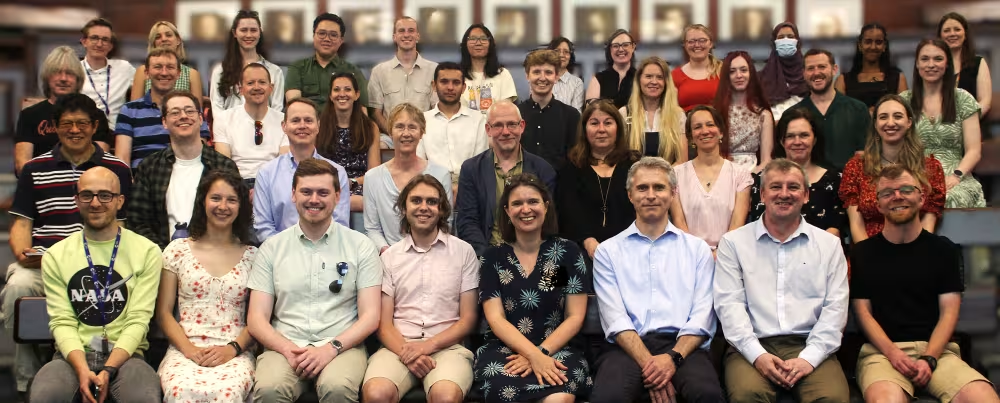
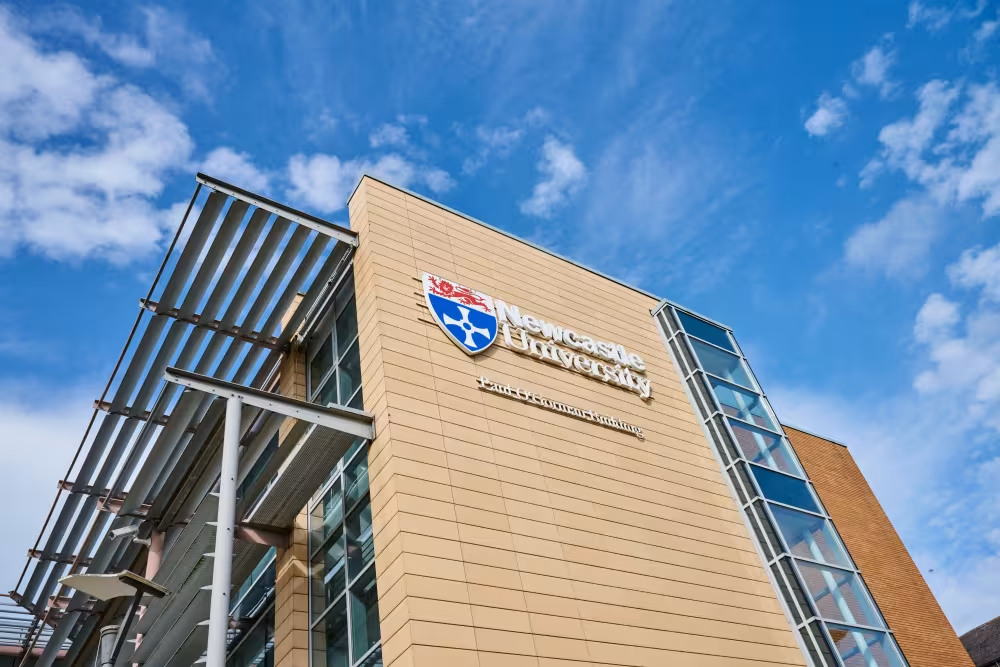
It is fitting that one of the best examples of this happening is in Newcastle, with its iconic seven bridges arching over the River Tyne into Gateshead. The Newcastle Drug Discovery Group, nestled at the edge of the Town Moor a couple of miles north of the river, is an academic lab that works closely with industry partners to find new treatments for cancer patients. The group has built a portfolio to rival many biotech companies, helping to discover two approved cancer treatments, sending two more into the clinic, with yet more in the discovery phase.
But what led to this success?
A unique arrangement
The Newcastle Drug Discovery Group formed in 1990 with funding from what would become Cancer Research UK. A year later, Newcastle University signed its first technology transfer agreement with the charity, making it Cancer Research UK’s longest-running academic partnership.
When Cancer Research Horizons launched in 2022, the Newcastle site became part of our drug discovery division, Therapeutic Innovation, with our Chief Scientific Officer Steve Wedge leading the group. However, the Newcastle site is unique: while the drug discovery scientists at our five other sites are all Cancer Research Horizons employees, with roles that mirror those in industry, the members of the Drug Discovery Group are all university staff. They are academics first and foremost. This arrangement allows the team to explore the areas of research they want while still having a direct link to industry.

“Having an academic group means that you do a lot of things that you couldn’t do if you were based in a biotech organisation,” said Mike Waring, Professor of Medicinal Chemistry at Newcastle University and part of the group’s senior leadership team. “We can develop new methods of drug discovery. We’ve done a lot of work in developing new ways of doing fragment screening, new ways of discovering covalent ligands.”
While industry scientists will use these technologies too, they generally do not have as much opportunity to develop them further. And Mike should know. Before joining the group in 2015, he worked at AstraZeneca for 14 years where he contributed to the discovery of 14 clinical candidates including osimertinib (Tagrisso), the most widely used EGFR inhibitor for lung cancer.
“I have a privileged position in that I’ve worked in industry and I still work in drug discovery,” said Mike. “I see what the problems are, which allows me to formulate potential solutions to those problems.”
This unique arrangement not only allows the group to explore new discovery techniques. It also allowed them to identify a new class of cancer therapies.
Pioneering PARP inhibitors
In the early 1990s, researchers at Newcastle University had started exploring if blocking the DNA repair enzyme known as PARP could be used to treat cancer. This was a bold direction to take. The cells in our bodies rely on DNA repair mechanisms to prevent mutations and protect us from cancer and many pharmaceutical companies thought the approach was too risky to invest in it.
That’s where Cancer Research UK came in. The charity funded the initial research into PARP inhibitors and – with our predecessor Cancer Research Technology supporting all commercial activity – helped to set up the Drug Discovery Group. Through a collaboration with Agouron Pharmaceuticals, the team discovered the PARP inhibitor rucaparib, which entered the clinic in Newcastle in 2003 in a trial sponsored by Cancer Research UK’s Centre for Drug Development. It was the first time ever that a PARP inhibitor had been given to a cancer patient.
Rucaparib is now approved in two different indications in ovarian cancer, marketed under the trade name Rubraca by Pharma&, and being used to treat tens of thousands of patients worldwide. Along with another Cancer Research UK-sponsored group at the University of Cambridge, which developed olaparib, the Newcastle Drug Discovery Group pioneered the development of PARP inhibitors, paving the way for a new class of cancer therapeutics.
At the time, the early research into these treatments was only possible in an academic setting with charitable funding, but the team knew that they needed to work with industry to get the drug to patients. This is the other key to the group’s success.
Working with industry
Following their work on PARP inhibitors, the Newcastle Drug Discovery Group wanted to develop a selective FGFR inhibitor to treat cancer. FGFRs are tyrosine kinases that aid cell growth and development but can become mutated in certain cancers to drive tumour growth.
The group began collaborating with Astex Pharmaceuticals, a world leader in fragment-based drug discovery, and together they discovered several promising compounds with significant activity in FGFR-dependent tumour models. Astex used those compounds as the basis for a further collaboration with Janssen, which led to the clinical development of erdafitinib.
The US FDA approved erdafitinib, marketed as Balversa by Janssen, for certain bladder cancers in 2019 and recognise it as a first-in-class medication. In 2024, the US, UK and EU approved erdafitinib for specific urothelial carcinoma indications, allowing even more patients to benefit from this treatment worldwide.
Newcastle’s partnership with Astex did not end there though.
The Astex alliance
In 2012, the Newcastle Drug Discovery Group began a multi-project alliance with Astex, managed by Cancer Research Horizons’ Commercial Partnerships division, creating a direct link between the independence of academia and the developmental capabilities of industry.
Maria Ahn, VP, Head of Bioscience at Astex, spoke about the benefits of the partnership. “We’ve learned a lot from each other while pushing our drug discovery programmes forward, weaving in innovative science and high-quality research into our projects,” she said.
One of these programmes resulted in the discovery of ASTX295, a small molecule drug that restores the function of a tumour-suppressing protein called p53. This protein is faulty in at least 50% of cancers but was previously thought to be undruggable. However, Newcastle and Astex found a way.
ASTX295 works by targeting the interaction between p53 and one of its key regulators, MDM2, to restore the protein’s tumour-suppressing function. Unlike other MDM2–p53 antagonists, ASTX295 has a shorter duration of action in patients to avoid longer-term toxic effects in bone marrow.
Maria was involved in this project from the beginning. “I saw how the Newcastle University team brought forward a novel concept for limiting on-target toxicity and ultimately make a better, safer drug for patients,” she said. “What followed was highly collaborative, dynamic and rewarding teamwork that led to a differentiated compound in the clinic.”
The results from the clinic were positive, with the Phase 1 trial showing that patients tolerated ASTX295 well at clinically effective doses without significant impact on their bone marrow. In 2025, Astex licensed ASTX295 to Mosaic Therapeutics to continue its development. We will be watching closely to see how the candidate progresses.
The next generation
Jane Endicott, Professor of Cancer Structural Biology at Newcastle University and one of the principal investigators in the group, appreciates how their direct link with industry can smooth the translational path out of academia. Before joining the Drug Discovery Group in 2011 she was Professor of Structural Biology in the Department of Biochemistry at the University of Oxford.

“As someone who came from discovery science, I hadn’t appreciated until I moved to Newcastle just how rigorous and demanding the criteria are to prosecute something as a drug discovery project,” she said. “What’s the clinical positioning? What’s the competition? What are your appropriate cell models? Gaining an appreciation of what’s required over and above your expertise in a particular area is so important.”
Mike echoed this idea. “We can help translate academic research, taking fundamental new cancer bioscience from the Cancer Research UK network and looking for new opportunities for drug discovery within that research,” he said. “That is something that you can do uniquely well if you’re embedded in academia because you have the trust, you have the relationships, you have the networks. You go to the right meetings.”
The other advantage of being in a university is the opportunity to pass on their skills. “You’ve got to train the next generation of cancer researchers,” said Jane. This is particularly important in drug discovery, where projects can outlast even the most generous tenures.
“We teach undergraduates. We train MRes students and PhD students,” she continued. “We are teaching them and that’s getting them enthused about drug discovery. That is a key aspect of what we can offer at Newcastle.”
Bridging the gap
There are few better places to get enthused about drug discovery and cross-sector collaboration than in the Newcastle Drug Discovery Group. Over more than three decades, it has maintained the trust of academia while earning the respect of industry – pulling down the wall between the two sectors and building a bridge in its place.
Hadrian’s Wall, built to keep barbarians out of the Roman Empire, ran through the site of Newcastle. You can still see remnants dotted around the city, but they’re now small enough to step over. Likewise, the boundary between academia and the pharmaceutical industry is small enough to step over in Newcastle, in a city better known for its bridges than its walls.