

About Xterna
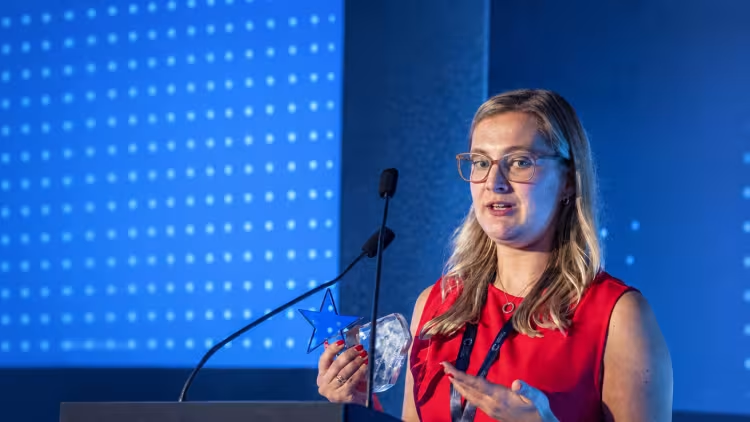
Xterna is a biotechnology research company dedicated to using alternative nucleic acids to revolutionise targeted drug discovery. Xterna won the 2024 Nucleate Venture Prize and the 2025 Pioneer x Daiichi Sankyo Golden Ticket competition. Its CEO, Jessica Corry, was Early-Career Entrepreneur of the Year at our 2025 Innovation and Entrepreneurship Awards.
Hi Jess, thank you for taking the time to sit down with me. To start off, I’d love to know where your journey to entrepreneurship started. When did you first think you might become a founder?
I caught the bug during my PhD at Cambridge, which has a really busy entrepreneurial ecosystem. My PhD was a slightly unusual one because although I was registered with the university and an academic lab, I actually spent several years based at AstraZeneca. At the time of applying for my PhD, I really thought I’d work in big pharma forever.
I’d always been interested in cancer biology, and therapeutic approaches. It’s all well and good understanding the molecular detail of what drives cancer and getting a nice paper from your research, but what I cared about was using scientific knowledge to treat it. At the end of my undergraduate studies in Sheffield, I thought pharma was the route to ensure my work has tangible impact on real patients – they’re the ones running clinical trials and developing new drugs.
I learned a huge amount at AstraZeneca, including how R&D operates, how priorities of large organisations can shift quickly. This experience was incredibly valuable and directly informs the company I’m now building, which aims to provide external innovation to large pharmaceutical companies.
I did realise though that ultimately, I wasn’t a match for big pharma R&D if I wanted to pursue very novel science. I still remember reading the paper that inspired Xterna’s creation and thinking, how have we not known this before? If this is true, it could completely change therapeutic outcomes. I knew that in order to pursue that kind of high-risk science, I would need to move on.
So the idea for Xterna started during your PhD, what did you do next before setting up the company?
I needed some time to convince myself that this new research finding was real, especially if I was about to dedicate my life to it. And critically I was a fresh PhD graduate, and I didn’t feel I was ready to establish a biotech company yet, so I moved to the Francis Crick Institute as a postdoc. My plan was to gain the skills I needed to transition from a wet-lab scientist to biotech executive. It was at the Crick that I met someone very important in my research group: my co-founder, Dr Chris Wan.
Chris is a synthetic biologist; he thinks about biology as a set of building blocks and is incredibly skilled at using alternative nucleic acids to control and manipulate outcomes. This skill set was extremely compatible with the novel antigen I was curious about.
But it wasn’t just the science that aligned for us. We spent months getting to know each other before even talking seriously about starting a company. We became friends first – we’re both obsessed with musical theatre, so a lot of our early conversations in the lab were not about science at all, but about what show we were going to see next. That personal rapport really mattered. When we eventually did consider being co-founders, we used our first accelerator programme (Science Creates' Accelerate in Bristol) as a kind of test: can we actually run a company together? It worked, and that gave us the confidence to move forward and register Xterna!
I always say you have to be comfortable with being uncomfortable in this role. If that terrifies you, this job is probably not for you.
What would you say were the biggest hurdles you faced when you were forming the company?
One of the biggest challenges at the beginning was confidence – I was surrounded by people in Cambridge who were commercialising their research, spinning out companies, closing Series As. On the one hand, that makes you think, if they can do it, I can do it too. On the other hand, it creates huge imposter syndrome: were we the right people to found and run a biotech company?
I kept thinking, I have a PhD, I’ve worked in pharma, but there’s so much I don’t know. The hardest step was making the jump to say: I know I don’t know everything, but I am confident I can find the right people who do.
That’s why we did so many accelerator programmes. We were part of Nucleate in the UK, Science Creates' Accelerate (an Innovate UK-funded programme), Founders at the University of Cambridge, and the BII Venture Lab Program. These programmes helped build our confidence, tighten our narrative and get our dataroom investor ready.
I remember in one of the last programmes we did – someone just said, “Why aren’t you fundraising yet? This is ready.” Getting this feedback from successful mentors, investors and previous exited founders gave us the push to go for it.
Even after the intensity of first launching a company, I’m sure there are still challenging times as a CEO. What gets you through the tough moments?
I always say you have to be comfortable with being uncomfortable in this role. If that terrifies you, this job is probably not for you. You have to accept that things won’t go to plan and just get on with it.
What really gets me through the tough moments is the network I’ve built. I’ve spent a lot of time surrounding myself with people who are doing what I’m doing. When you’re having a really tough day or week, it helps to be able to reach out to someone and ask, have you experienced this before?
Sometimes it’s not even about solutions – it’s just having the space to talk to someone who actually understands. I have peers in London, in Cambridge and globally through Nucleate. If I’m in Boston, there are people I know. If I’m in San Francisco, there are people there I know.
We also have advisors who are five years further down the line than us. That’s incredibly valuable, because they’re not just in the pit with me – they can say, this is how I got through it. And then I also have more personal mentors who remind me that when you’re working on very novel science, there’s always a risk it just doesn’t work. That doesn’t mean you’ve built a bad company or done things wrong – it’s just the nature of what we’re doing.
And also – listening to Hamilton. Countless hours of listening to Yorktown and the sweet dulcet tones of Leslie Odom Jr. That soundtrack has got me (and therefore Xterna) through a lot!
Are there any hard lessons you’ve learned on this journey, or things you’d change if you were to do it all again?
Private capital, especially in Europe, is highly risk adverse. As two junior academics discussing a moonshot idea of how we could target therapeutics, we were understandably a hard sell to some.
Fundraising involves a lot of rejection. I was advised early on that you’ll knock on 100 doors and get 99 ‘no’s – some of them will tell you you’re wrong, that your idea will never work, that you are incapable – but the last door will be a ‘yes’. You need grit take the 99 ‘no’s in order to get to that ‘yes’.
You have to remind yourself that what you’re doing is correct, will change the world if true, and that you are the right people to do this. That determination is what investors want to back – that whatever difficulties we face, Chris and I will find a way through.
You have to remind yourself that what you’re doing is correct, will change the world if true, and that you are the right people to do this. That determination is what investors want to back.
It sounds like you’ve been very resilient. Where would you say that comes from?
100% from my dad. Being a business owner isn’t unusual in the Corry family; I’ve seen that as normal my whole life, including the stress that it can bring. Although slightly different in nature to a biotech, my dad rents out bouncy castles. (Yes, my birthday parties were pretty epic as a child!)
On a resilience building note, when I was a teenager, my dad’s business was completely destroyed in an arson attack. I remember watching him clear up the burnt scraps of a company he’d spent over a decade building. The next day, he got up and started to rebuild it, bigger and better.
So when everything feels like it’s going wrong, I always think: I’ve seen the worst-case scenario. Everything can be taken away – and it can still be rebuilt.
We’ve focussed a lot on the challenges and difficulties of forming a company. To finish, could you share your proudest moment so far as a CEO?
One of the biggest pleasures so far has been hiring a team and watching the science come to life – that’s been amazing. Xterna isn’t just an idea anymore, it’s come to life.
I feel the difference now at our celebrations too. In 2024, Chris and I had our Christmas meal with two advisors because we’d just closed the round. In 2025, we had a Christmas meal with a full team. That was a special moment. Obviously we’re here to make therapeutics, but building a company where people actually want to come to work every day really matters to me. Winning the Daiichi Sankyo-Pioneer Golden Ticket competition was also a massive morale boost. That kind of external validation makes the whole team feel like, okay, we’re really working on something big that people value!