
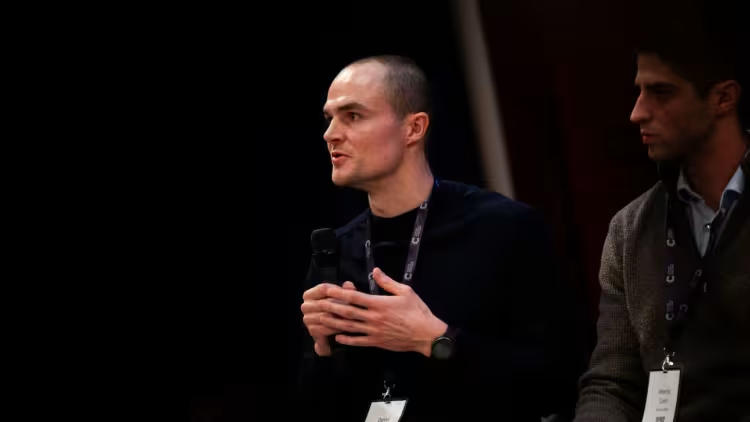
Dan Lucy is not long back from San Francisco when I speak to him. He was there during the J. P. Morgan Healthcare Conference, which he describes as a lot of fun if a little overwhelming, with hundreds of events all over the city and the nagging suspicion that you’re always at the wrong one. “It reminded me of Rio Carnival,” he says. “But with fewer sparkles.”
Dan was there to pitch his company Siftr Bio, which launched in early 2024 to create next-generation antibody drug conjugates (ADCs) with higher efficacy and lower side effects. So far, so familiar: investment in ADCs has surged in recent years, causing many new start-ups to flood the field and existing companies to add them to their pipelines.
What makes Siftr different is that it’s aiming to bring about this next generation not with new antibodies or more potent payloads, but by redesigning the linkers that tether them together.
The less glamourous component
There are three parts in an ADC: a tumour-targeting antibody, a toxic payload, and a linker connecting the two. The antibody delivers the drug to the tumour and the payload kills the cancer cells, but it’s the linker that determines when and where that payload is released.
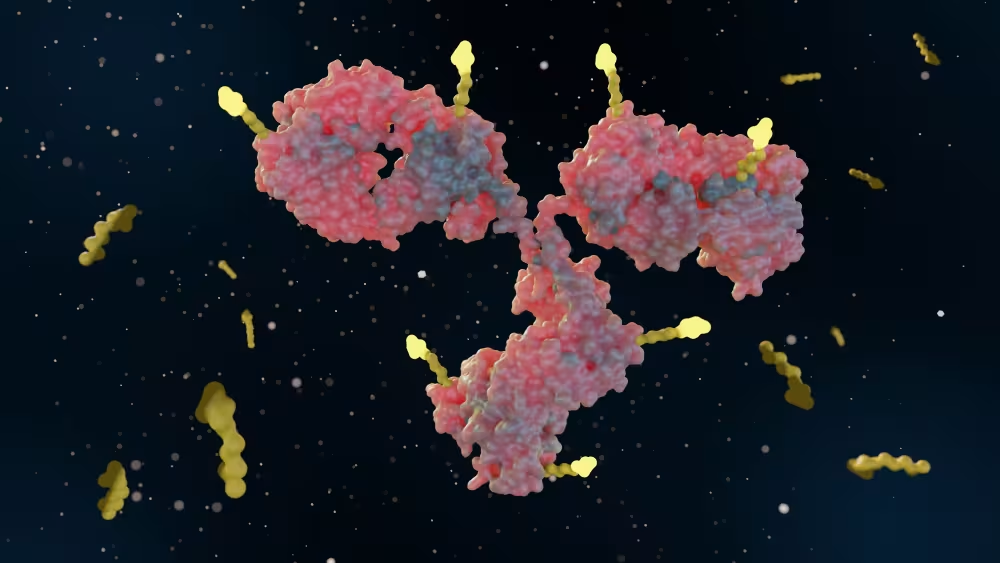
“Maybe it’s slightly less glamorous,” says Dan, “but it’s super important.” If the linker is unstable, the toxic payload might release too early and harm healthy tissues. If it’s too stable, the payload might not release at all, and the drug would be less effective. But if you can get the linker right, you can create highly selective treatments for many hard-to-treat cancers.
Only in the last five years have people realised that the linker is key.
It’s a relatively untapped area for innovation. “A lot of the linkers used in current ADCs were designed in the 1990s,” says Dan. “People have been innovating the antibody, they’ve been innovating the payload, but only in the last five years have people realised that the linker is a key component for the performance of your ADC.”
The other thing that sets Siftr apart is that the team are using human tissue to design the linkers. They analyse samples of tumours removed from patients to identify biochemical features that they can harness to dial up selectivity. Other companies might use human tissue for validation, but few are using it this early in the design process.
“It gives us a unique advantage,” says Dan. “We know that the molecules we’re designing have specific properties that will help translate into patients.”
An Imperial ecosystem
The origins of Siftr lie in Dan’s postdoc at Imperial College London, where a surgeon approached his research group looking for chemists to help interpret patient samples. The collaboration came together quickly – something Dan puts down to Imperial’s ecosystem, where a research-intensive university sits in a city dense with NHS hospitals. In that environment, he says, getting projects like this off the ground is remarkably easy.
Coming from his PhD at the University of Oxford, which Dan describes as much more abstract, working with human tissue samples brought his work closer to patients – the missing link between his research and its potential impact.
“It reminds you that someone has undergone surgery, maybe earlier that day,” he says. “You can’t escape it. It really focuses the mind.” That focus also ignited an interest in commercialisation, which Dan saw as the best route to seeing his research benefit patients.
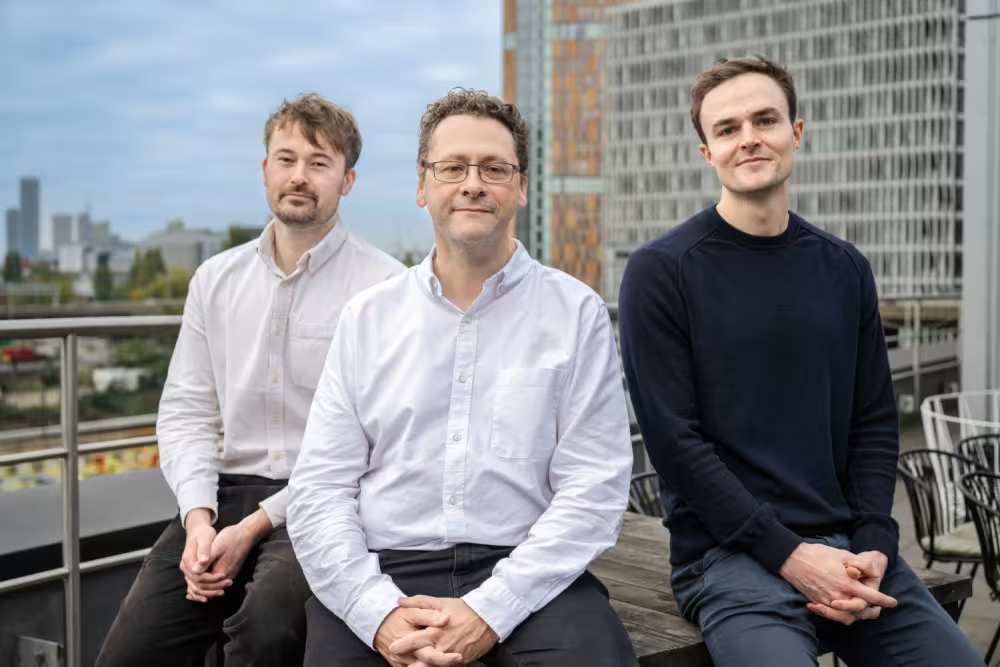
He had been developing a technology that would allow very selective activation in specific disease tissue, but wasn’t sure how best to apply it. He joined Imperial’s entrepreneurial training programme, Techcelerate, to help validate the idea but the direction only became clear when he started speaking to his co-founder and now Siftr Bio’s Chief Scientific Officer, Archie Wall, whose background was in ADCs.
For Archie, the application was obvious. He knew about the challenges around payload release in ADCs and thought Dan’s technology could be a solution. Serendipitously, this was also around the time when ADCs were starting to blow up, following a wave of approvals and growing investment in the field.
Archie and Dan were both in the research group of Siftr’s third co-founder, Ed Tate, who had experience spinning out companies from co-founding Myricx Bio a few years earlier. With a trending modality, Ed’s experience and their university’s support, the foundations for another spin‑out were strong. However, it took Dan leaving Imperial to get the perspective he needed to launch the start-up.
Liberation from academia
By the time he’d finished his postdoc, Dan had been in academia for over 10 years and had felt his mindset changing during that time. “I knew I didn’t want to be a professor, which was a liberating feeling,” he says. But what did he want to do? He knew he was interested in medicines but thought he’d probably end up in big pharma.
“The idea of company formation wasn’t even on my radar,” he says. That was until his principal investigator at Oxford launched a start-up, his first exposure to an academic spin-out. Later, a year after Dan started his postdoc, Ed Tate launched Myricx. Company formation still seemed like the preserve of senior researchers, but it had opened his eyes to the possibility. He joined Imperial’s entrepreneurial programmes – more out of curiosity than any solid intention to start a company.
“It’s the existential question that postdocs start to ask themselves: what’s the next step?” he says. It wasn’t until he left academia that he could answer that question. “Your thinking can be narrow when you're a PhD student or a postdoc,” he says. “It can be hard to see the big picture.”
For Dan, the best way to see the big picture was to travel the world. He went backpacking around Latin America and Asia, with a brief stint back in the UK for his brother’s wedding and, it turned out, to recover from typhoid. “I slightly ruined the wedding photos,” he says.
During his trip, Dan remembers listening to another founder on a podcast saying that when he first convinced an investor to give him money, he didn’t really have any ideas. This was a turning point for Dan: “But I do have ideas,” he thought. “Why have I not had the conviction to take this forward?”
The critical mass
With that realisation, Dan and his co-founders launched Siftr early in 2024. By that summer they’d completed the Cancer Tech Accelerator, a programme run by Cancer Research UK, Cancer Research Horizons and Capital Enterprise, which Dan says was particularly useful. “One of the challenges of setting up a company is the sense of it being directionless,” he says. The accelerator provided a structure to navigate the path forward.
Dan says programmes like this have increased UK scientists’ appetite for entrepreneurship, which has historically been less strong than in the US. “The missing piece to some extent was the critical mass of people actually doing it.” Incubators and accelerators allow people to do it without obligating anything from them other than their time and focus. And they’ve proved useful in running Siftr. “Basically, all the things I learned on these programmes have come true.”
When you’ve identified something that’s good, you need to capitalise on it.
Not long after the Cancer Tech Accelerator, which awarded Siftr a £70,000 grant, the team raised £1m in pre-seed investment, allowing them to spin out from Imperial and move into the university’s White City Incubator, where that critical mass is evident by their neighbours. “There’s a big ecosystem of companies here,” says Dan. “A lot of them are really early stage, but there’s the full food chain.”
Now, Siftr is searching for the missing links in that food chain by proving its principle and raising investment. Dan appreciates the urgency. “When you’ve identified something that’s good, which we have, you need to move and capitalise on it.”