
If there is one structural brake on oncology spin-out creation, it is the gap before incorporation. Proof-of-concept and pre-seed stages remain chronically underfunded, but it is precisely at this stage where even a small amount of extra funding could create the biggest impact.

Too often, companies are incorporated prematurely – not because they are ready, but because there is no structured, well-capitalised bridge between academic validation and venture-scale seed investment. This results in fragile companies spending their first year raising capital rather than strengthening their data.
There is also a geographic imbalance in available funding. Two thirds of venture capital flowing into UK spin-outs is concentrated within the golden triangle. Oncology innovation is distributed nationwide, but capital is not. Specialist investors with the domain expertise to evaluate and lead complex oncology rounds are thinner on the ground outside established hubs. This creates friction for companies emerging from outstanding regional centres of research.
These structural gaps are all laid out in the recent UKRI report, Deepening University Innovation and Investment, written by our Chief Business Officer, Tony Hickson. To truly maximise the impact of the UK’s world-class science and get innovations out of the lab and into scalable companies that benefit patients, we need to address these gaps.
The rise of alternative investors
Fortunately, there is a growing category of alternative investors to do just that. When I first started at Cancer Research Technology (the predecessor to Cancer Research Horizons) over 20 years ago, we routinely struggled to raise even modest seed rounds for genuinely exciting oncology projects; there was very little specialist capital in the UK willing to touch pre‑clinical science.
Early engagement allows risk to be addressed inside the science – rather than deferred to the first investment round.
The first wave of specialist funds emerged around a decade ago and started to give oncology propositions a fair hearing, resulting in a marked improvement in early management teams. More recently, there’s been a shift towards pre-incorporation engagement, which has been one of the most transformative changes. Since then, we’ve been working with investors and venture builders before a company even exists. That simply didn’t happen 20 years ago.
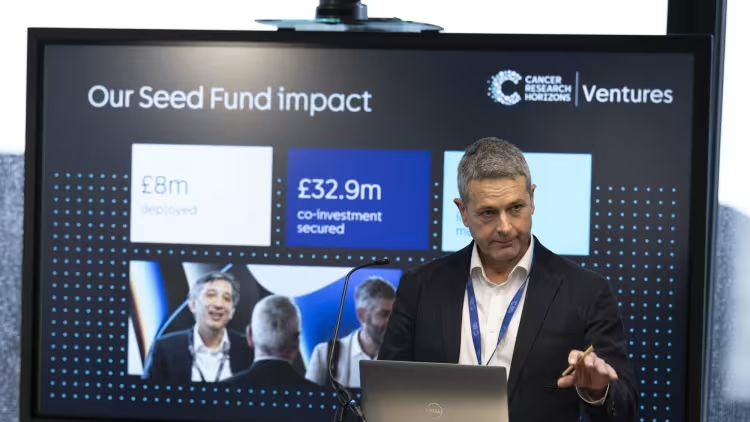
And now, we are part of the revolution. As the innovation arm of Cancer Research UK, we operate as both venture creator and specialist investor, with a dedicated Seed Fund. We work alongside researchers well before incorporation, supporting the generation of critical proof-of-concept data and helping shape commercially coherent strategies from the outset.
This early engagement allows risk to be addressed where it is most tractable – inside the science – rather than deferred to the first investment round. By the time a company formally launches, it is positioned to engage institutional capital with greater clarity and credibility.
A growing cohort
Cancer Research Horizons is not alone. There are many mission-driven funds linked to charities, hospitals and universities that are part of the revolution too. Their mandates extend beyond financial return to long-term patient impact, enabling an enduring approach to early-stage risk.
This cohort has grown in response to a huge cultural shift among the academic community: many researchers used to equate commercialisation with selling out; now, more and more of them see entrepreneurship as a credible path to impacting patients. Specialist capital providers are meeting them where they are.
Some of the most compelling oncology opportunities will be long before a Series A is formally launched.
Collectively, these alternative investors expand the ecosystem’s capacity at the precise points where it has historically been constrained. For institutional life science investors, this cohort should be viewed as complementary rather than competitive. Strong collaboration between alternative investors and mainstream venture capital has the potential to improve both capital efficiency and long-term outcomes.
For life science investors, the message is clear. Some of the most compelling oncology opportunities will be shaped in partnership with mission-led and affiliated funds long before a Series A is formally launched. Engaging early with these alternative investors will provide access to high-quality science and more mature company propositions.
At Cancer Research Horizons, I see every day how mission-aligned capital, deployed early and thoughtfully, can drive progress in oncology innovation. For patients waiting on new cancer therapies, that progress cannot come soon enough.